
Fyntralis Fyntralis
Do we record VAT at entry or at period close?
Chapter 01
17 Nov 2026

Korea Compliance Guide

VAT and e-invoicing workflows explained for Korea.

South Korean businesses keep books in KRW, issue electronic tax invoices through approved channels, and prepare VAT records by period. This page explains those workflows in operational terms: what to record, what to attach, and what to hand to your tax professional. Educational guidance only, not tax advice.

Who this is for

Owners and office teams who keep the daily book and hand the period pack to a licensed tax professional. If you already know the difference between a cash receipt and a tax invoice, you can still find the working rules here.

Evidence check — the balance we look for

Sales tax recorded at entry, period total tied to evidence
Reconciled

Chapter 01

How VAT shows in daily bookkeeping

Sales and purchases carry tax type and rate at entry so period totals tie to evidence. Correct coding on day one saves hours at close.

Where does the rate land on the row?
01 · Entry

Korean domestic sales carry a tax type at entry: taxable, zero-rated, or exempt. The rate sits on the line, not in the memo, so the period total can be rebuilt from the ledger without opening a spreadsheet.

Card sales summaries arrive as a batch. Post them by settlement date and keep the batch reference next to the deposit, so the bank line and the sales line both point at the same evidence. Cash receipts follow the same habit: record the receipt, then attach the slip.

Common error: mixing tax-inclusive and tax-exclusive amounts on the same account so the period total never agrees with the evidence.


What evidence belongs to a cash sale?
02 · Trace
Card sales summary sheet beside receipt slips and a bank slip on warm ledger paper

Cash receipts need two things: the receipt the customer holds, and the record in your book that names the same amount, date and counterparty. If the record is missing, the period total will still be right, but you will not be able to explain it — and a period you cannot explain is one you cannot reconcile.

Chapter 02

Electronic invoicing Korea in practice

Electronic tax invoices move through approved channels, and each one is bound to a real sale. The three flows your book has to carry are issuance, cancellation, and correction — and each leaves its own reference in the ledger.

On issuance, record the invoice number next to the sale row so a search of the number finds the sale and its attachment. On cancellation, keep both the original and the cancelling document, or the period will show a sales line with no matching tax line. On correction, note the reason in the row itself; corrections without a reason are the ones that get questioned later.

Retainers and part-payments need their own note. A retainer is money received against future work — it is not yet a sale, so it does not carry a tax line until the work is delivered. Part-payments against a single sale usually reference the same invoice with a running balance so the sum of the payments equals the invoice total.

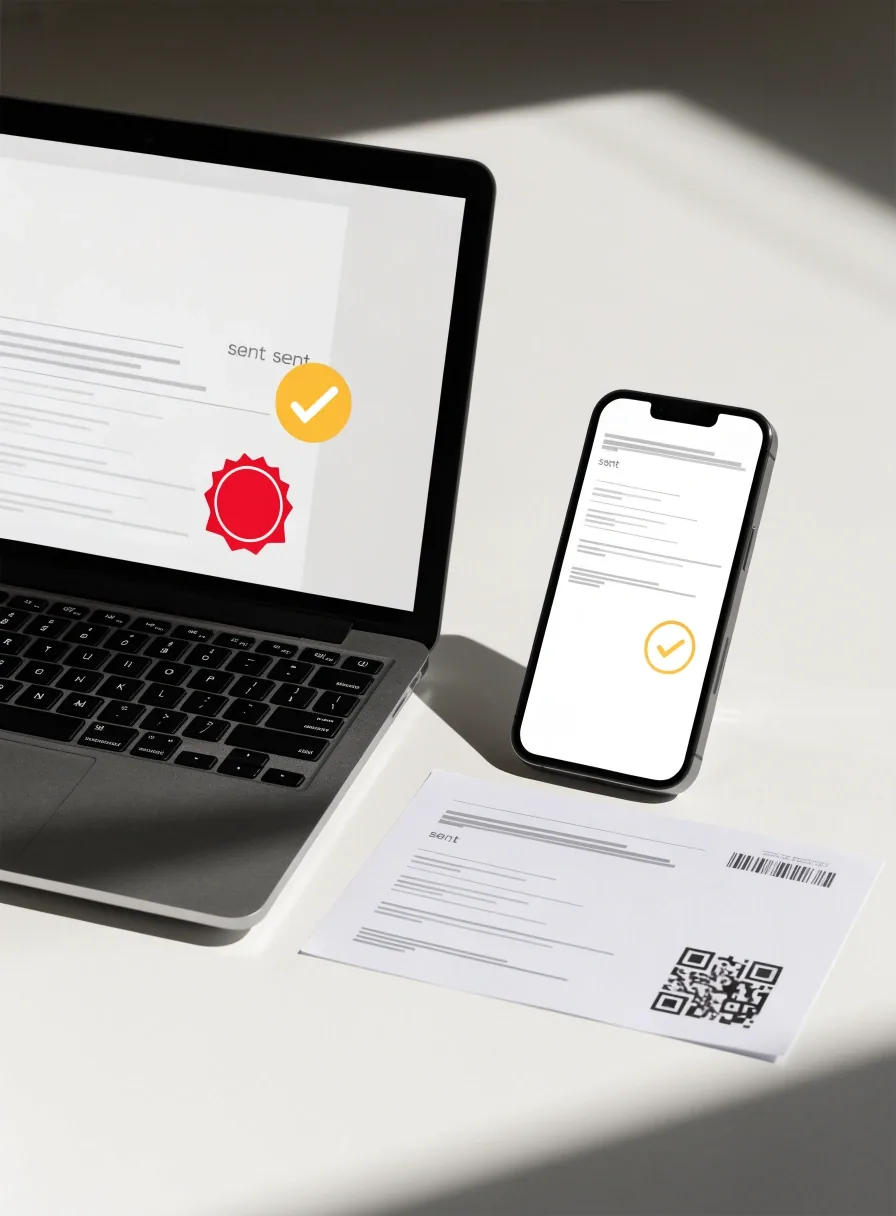
Laptop with an angled blurred invoice glow beside a printed confirmation with a QR code and a smartphone

Keep the invoice number searchable in your accounting record — a search string, not a filing cabinet.

Chapter 03

KRW accounting and bank evidence

Each KRW movement leaves a different trace. Match the habit to the trace.

KRW movement
Trace it leaves
Habit to keep
State
Bank transfer
A dated bank line with a memo, sometimes numbered, sometimes blank.
Reconcile against the counterparty and the document it settles, not only the amount.
Routine
CMS debit
A recurring debit stamped with the mandate reference.
Post against the contract or schedule that authorised the debit, so the recurring cost stays explainable.
Routine
Card settlement
A settlement batch that groups sales by processing date.
Keep the batch reference with the deposit, and post the fee as its own line — never netted silently.
Routine
Cash receipt
A paper slip and a same-day book line.
Write the counterparty and the reason in the row itself — the slip will not hold them for you.
Routine
Personal transfer
A dated line that does not belong to business activity.
Keep it out of the business book; if it must appear, mark it clearly and reconcile it separately.
Review

A bank memo that names the payer and the reason makes reconciliation a two-minute read. A vague memo turns a small sale into an afternoon of detective work. If your bank lets you attach a memo, use it — it is the cheapest discipline the office has.

Personal transfers reached the business account by accident are the most common break we see. Handle them the day they arrive, not at month-end; the later they slip, the deeper they dig into the period you already believe is closed.

Ruled pages of an open paper bank passbook beside a stamped receipt reel on a warm desk

Bank evidence stays close to the ledger row it explains, so the next reader does not need the whole story.

Two people's hands passing a payroll folder across a desk with a closed laptop behind

Chapter 04

Payroll handoffs and year-end records

Payroll itself often runs with a provider or an in-house tool. Accounting records the cost, the liabilities and the payments — three different rows, three different purposes. Keeping them separately labelled is what lets the period total agree with the payroll summary without a manual recount.

Monthly postings cover the gross wage cost, the withholding amount, the employer contributions and the net payment. The withholding record keeps its own running reference; at year-end the summary is built from those references, not from the bank lines. Small teams in Mapo or Gangnam typically assign one approver and one preparer, and the separation matters even in a five-person office — not as ceremony, but so a payroll change can be traced back to the person who authorised it.

Archive the twelve monthly summaries with the year-end summary in one folder per year, named so an outsider can find December without a guide. That single habit saves the most hours in the week the year closes.

Chapter 05

Period close before filing preparation

Close is a sequence, not a mood. Reconcile, review, check the codes, lock the period.

Close checklist — bring this pack

  1. 01
    Reconcile every bank account to the ledger, including the personal-transfer exceptions you already handled.
  2. 02
    Review receivables: which invoices are already issued but not yet paid, and which retainer balances remain open.
  3. 03
    Review payables: which supplier invoices are matched to a receipt, and which are still waiting for the goods.
  4. 04
    Check tax codes on any row posted in a hurry — the end of the period is the last quiet moment to fix them.
  5. 05
    Lock the period. A locked period is a boundary a reviewer can trust — and a boundary you can reopen for a documented correction.

Document pack order

Sort the pack as the filing conversation will use it: bank reconciliations first, then sales and tax documents, then purchase documents, then payroll, then anything reviewed. Name the folder with the period and the entity, and you will save your accountant the first thirty minutes of the meeting.

What this step is not

Closing the book does not decide the filing. It brings a clean set of facts to the meeting so the professional can spend the hour on judgement instead of cleanup.

Chapter 06

Service versus product recordkeeping

The two shapes of business keep different records at the same level of discipline. Choose procedures that match your volume, not the one your neighbour runs.

Service firms
Design work
  • A
    Track each engagement as its own cost centre, so you can see which client pays the bills.
  • B
    Watch retainer balances — money received is not money earned until the work is delivered.
  • C
    Expense staff time against engagements when billable, and against overhead when not.
  • D
    Keep a fixed-asset register for project equipment once purchases pass a material threshold.
Product firms
Ship goods
  • A
    Track each supplier and each landed cost — freight, duty and handling belong to the item, not to overhead.
  • B
    Separate marketplace settlement fees from product cost, so margin is not flattered.
  • C
    Keep stock reconciliation on a schedule — the count that follows a good count is a habit, not an event.
  • D
    Register fixed assets for equipment and vehicles once the purchase is material to the year.

Chapter 07

Working with a Korean tax practice

Most small firms outsource filing to a seumu office (the local accounting firm many Korean owners work with) while keeping the daily book in-house. That split works when the roles are named, not guessed.

Who owns what
Role split
Your office
Daily entries, evidence, bank reconciliation, and the period pack. Keep the book you will need to defend.
Their office
Filing preparation, tax judgements, and the questions that the ledger cannot answer on its own.
Shared
Access roles, comment threads on bills, and a fixed monthly handover date.
Local workflows
Domestic platforms emphasise the electronic invoice lifecycle and VAT period preparation. International tools can record the same events but usually need extra steps for issuance and the filing handoff.

Clarity on roles prevents duplicate entry — the most avoidable cost in a small office.

Chapter 08

Records to keep and for how long, operationally

Keep invoices, receipts, contracts, bank records and payroll files organised by month and by counterparty. Statutory retention depends on the document class and on your own situation — ask your professional to confirm the period for your case; what this page can give you is the operational habit that makes the day of the question short.

Folder and file naming
Convention
By period
One folder per month per entity, so the year is a stack of months rather than one long river of files.
By counterparty
Inside a month, group by counterparty so a question about one supplier opens one subfolder, not twelve.
Bilingual labels
Korean and English in the folder names — the office team and the tax practice both find the folder without a translation step.
Access control
Payroll and personnel files sit in their own space, with access roles narrower than the rest of the office archive.
Reviewed, not archived
The archive is a working tool, not a graveyard — good archives turn audits into routine, and a routine audit is the least expensive one.

Questions we get asked

Before your next VAT conversation

Three questions our readers bring to the desk most often. If yours is not here, the contact page is the shorter route.

Q1 Which accounting tools support Korean VAT and electronic tax invoicing?

Korean-local platforms are built around those workflows. International tools can record VAT-style tax codes and attach evidence, but issuance and filing preparation usually involve local channels and your tax office. Our reviews note where extra steps appear.

Q2 Do we need an ERP for compliance?

Not necessarily. Many small firms stay compliant with a well-run cloud ledger plus disciplined evidence and a tax practice. ERP depth helps when approvals, multi-location stock, or manufacturing add complexity.

Q3 Is this tax advice?

No. Fyntralis explains bookkeeping operations. Filing decisions belong with your licensed professional.

Keep walking the guide you were reading, or move to the comparison table to see where each platform adds steps.